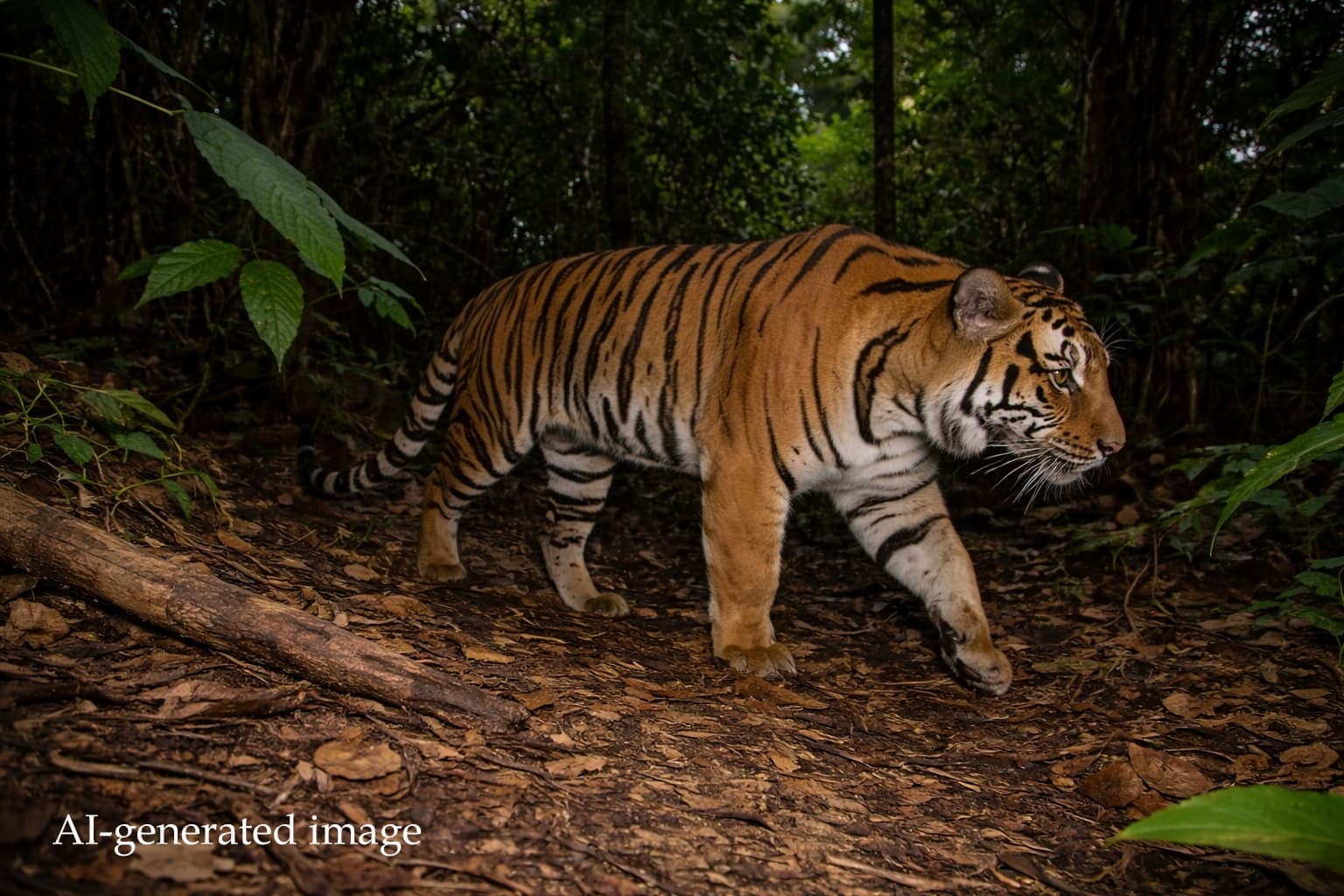
When Houssein Rayaleh received a WhatsApp message from a local ecotourism guide showing footage of a lioness in Djibouti, he was excited. The video showed the big cat running directly in front of a moving vehicle along Route Nationale 11, a road that Rayaleh knows well.
This was shocking. Lions are officially extinct here: There are no records of Panthera leo in this Horn of Africa country.
“I said whoa, we have a lion in Djibouti,” says Rayaleh, the CEO and founder of the NGO Djibouti Nature.
So he forwarded the video on to the Cat Specialist Group at the IUCN, the global wildlife conservation authority.
“As it happened, it was a fake,” Rayaleh says.
Certain details spring out in the video identifying it as an AI-generated video, says Urs Breitenmoser, co-chair of the group. “The lion behaves very strangely and there are also a few sequences where you can actually see that it is morphologically not quite correct.”
This video of a lion sighting in Djibouti was debunked, created using AI. Lions are locally extinct there. Video courtesy of Houssein Rayaleh. Creator unknown.
Luke Hunter, executive director of the Wildlife Conservation Society’s big cats program, described the video as “obviously very fake” after viewing it.
But to the untrained eye, these details are nearly impossible to spot, and some damage may already be done, Rayaleh says. It may have spread far and wide across the country via WhatsApp and social media channels. He received messages, including questions from government officials, asking if the video was authentic.
He says his concern now is that local people who saw the video might be spooked, as the region is home to farmers who already face human-wildlife conflict with leopards, spotted hyenas and African golden wolves. “Even if the lion is not occurring there, it is a threat for the other carnivores,” Rayaleh says, as it could cause persecution of these other predators.
Rayaleh says he doesn’t know who made the video, but suspects it was a genuine clip doctored using artificial intelligence to stitch in a lion. “The person who filmed this probably saw a goat on the road or a jackal and then they transformed it to a lion,” he says.
Fake imagery of wildlife isn’t anything new, Breitenmoser says. He recalls the case of the South China tiger back in 2008, when a clearly fabricated image was used to prove its alleged presence in Shaanxi province. “In the past these sorts of fakes were relatively easy to detect, he says. “Now, with artificial intelligence, it is getting more and more difficult.”
Skimming through social media, AI-generated images and videos of wildlife are ubiquitous. Technology is advancing rapidly, making it more challenging to identify a fake from the real thing.
That’s raising all manner of concerns among conservationists and wildlife experts. AI images of false animal sightings or attacks can create fear and spark panic or violence towards animals. Fake images spread misinformation about animal behavior, and fake footage or photos of people playing with or cuddling wild animals can feed demand for the exotic pet trade, endangering already threatened species.