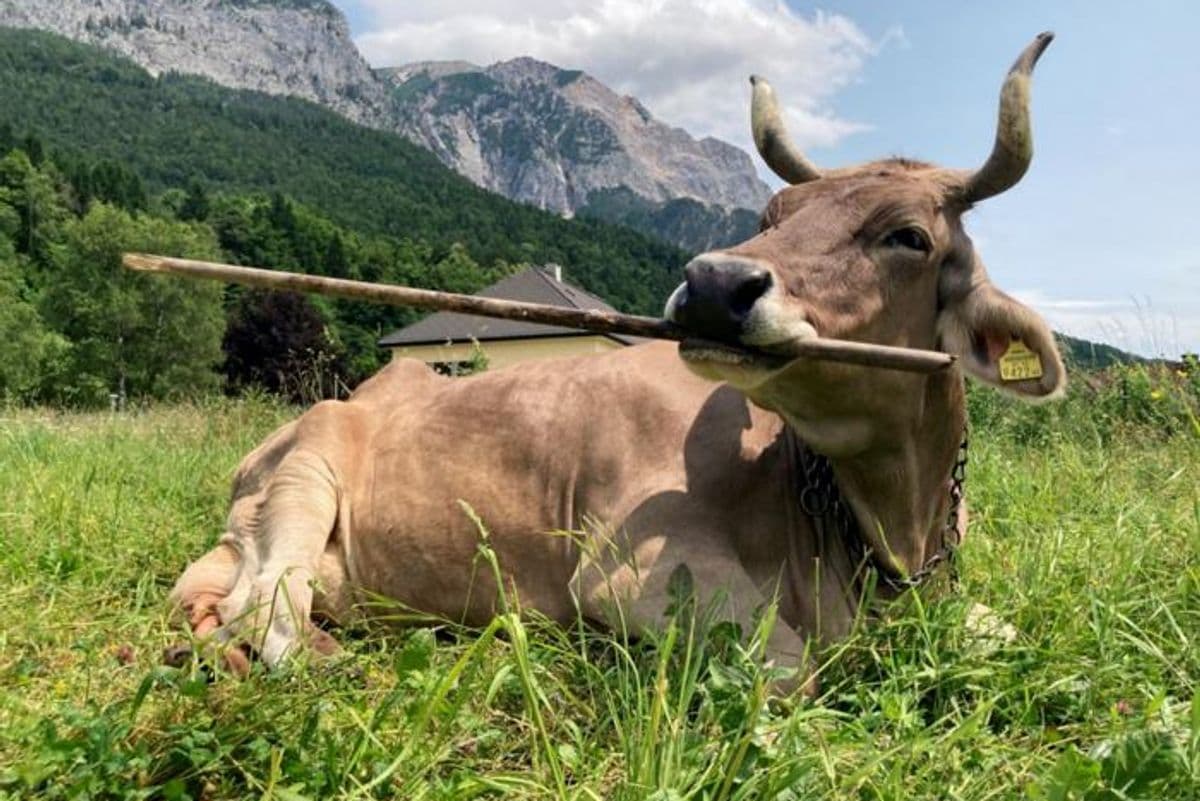
Veronika the cow reaches down and picks up a brush with her mouth. Instead of using it in a single, simple way, she rotates the object, selects different ends, and changes her movements depending on where she wants to scratch. The behavior looks purposeful and adaptable in ways that most scientists did not expect from cattle.
Scientists have now confirmed that Veronika is not acting by accident. A study published in Current Biology shows that this cow uses an external object with genuine flexibility, meeting the formal criteria for tool use. This discovery challenges long-standing assumptions about livestock cognition and suggests that the mental lives of animals traditionally viewed as simple could be more complex than previously thought.
“We show that a cow can engage in genuinely flexible tool use,” said Antonio Osuna-Mascaró, a post-doctoral researcher at the University of Veterinary Medicine, in a press release. “Veronika is not just using an object to scratch herself. She uses different parts of the same tool for different purposes, and she applies different techniques depending on the function of the tool and the body region.”
Read More: As an Ancient Cow Species Foraged For Seagrass, it Shaped Its Surroundings Around 21 Million Years Ago
Veronika’s behavior was noticed years before it was formally studied. She lives as a companion animal with an Austrian organic farmer and baker, who observed that she sometimes picked up sticks and used them to scratch herself. Unlike the fixed grooming brushes common in barns, these sticks had to be chosen, oriented, and controlled.
When researchers reviewed video footage of the behavior, they set out to determine whether Veronika’s actions were deliberate or incidental. Researchers traveled to observe her directly and designed controlled tests to assess how she handled an unfamiliar tool.
In these trials, a deck brush was placed on the ground in different orientations. The researchers recorded which end Veronika selected, how she positioned it, and which part of her body she targeted. Across repeated sessions, her choices followed clear patterns rather than chance, indicating purposeful use.
The experiments revealed that Veronika did not treat the brush as a single-use object. When scratching broad, less sensitive areas such as her back, she typically used the bristled end. When targeting softer areas of her lower body, she shifted to the smooth wooden handle.
Her movements changed as well. Scratching higher on her body involved broader, more forceful motions, while lower-body scratching was slower and more controlled. These adjustments suggest that Veronika anticipated how the tool would feel and modified her actions to suit the task.
In studies of animal behavior, tool use refers to an animal intentionally handling an object to produce a physical effect. Veronika meets that standard and then exceeds it. She uses different parts of the same object to achieve different results, a pattern known as multi-purpose tool use. Outside of humans, this kind of flexibility has been documented only in chimpanzees.
Because Veronika uses tools on her own body, her actions are classified as egocentric tool use. While this is often considered less complex than tool use directed at external objects, researchers note that she faces significant physical limitations, manipulating the tool entirely with her mouth.