🧪

Mad Science

27 stories

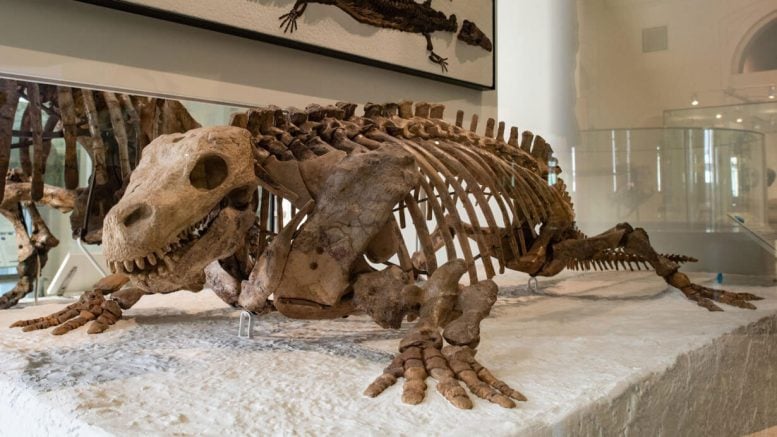
If We Knew Today’s Mammals Only from Fossils, We’d Get Evolution Super Wrong
🧪Mad Science

If We Knew Today’s Mammals Only from Fossils, We’d Get Evolution Super Wrong

A simulation demonstrates that relying solely on fossil records to understand modern mammals would lead to significant errors in interpreting their evolutionary history.

🌀
10
Genetic traces reveal 1,072 species in a single bucket of water
🧪Mad Science

Genetic traces reveal 1,072 species in a single bucket of water

Researchers from the University of Duisburg-Essen successfully identified 1,072 different species by analyzing DNA traces found in just two liters of water from the River Lippe. The study demonstrates a highly efficient, low-cost method for monitoring biodiversity in freshwater ecosystems.

🌀
10
Reconstructed Jurassic insect calls evoke a 165-million-year-old forest soundscape
🧪Mad Science

Reconstructed Jurassic insect calls evoke a 165-million-year-old forest soundscape

Scientists have reconstructed the ancient calls of Jurassic-era insects, specifically relatives of modern crickets and katydids. These audio simulations provide a rare glimpse into the acoustic environment of a forest from 165 million years ago.

🌀
10
Ancient rapid-fire weapon evidence found in Pompeii
🧪Mad Science

Ancient rapid-fire weapon evidence found in Pompeii

Archaeologists have identified square holes in the walls of Pompeii that may be the only surviving evidence of a polybolos, an ancient rapid-fire dart launcher used in 89 BC.

🌀
10
Fossil reveals ancient insect with 24 legs
🧪Mad Science

Fossil reveals ancient insect with 24 legs

A newly discovered fossil of a many-legged creature provides insight into the evolutionary history of insects and how they transitioned to having six legs.

🌀
10
Forces deep inside Earth helped Antarctica freeze before the Arctic
🧪Mad Science

Forces deep inside Earth helped Antarctica freeze before the Arctic

Scientists suggest that tectonic activity deep within the Earth lifted East Antarctica, creating high plateaus that allowed ice to form long before the Arctic. This geological uplift triggered a cooling effect that eventually covered the continent in glaciers.

🌀
10
Mice Lost Half of Their Brain Synapses. They Still Kept Their Memories
🧪Mad Science

Mice Lost Half of Their Brain Synapses. They Still Kept Their Memories

A hibernation study on mice revealed that the animals retained their memories despite losing half of their brain synapses.

🌀
10
Physicists Discover Time Crystals Can Communicate Across a Semiconductor
🧪Mad Science

Physicists Discover Time Crystals Can Communicate Across a Semiconductor

Researchers at TU Dortmund University have demonstrated that spatially separated time crystals within a semiconductor can synchronize their rhythms. This discovery shows the crystals can effectively communicate across distances.

🌀
10
Scientists finally know why astronauts struggle to poop in space
🧪Mad Science

Scientists finally know why astronauts struggle to poop in space

A NASA-backed study has identified the physiological reasons behind astronaut constipation during spaceflight. These findings highlight a previously overlooked health risk for long-duration missions to Mars.

🌀
10
A lost mega-cliff may explain the Grand Canyon’s missing billion years
🧪Mad Science

A lost mega-cliff may explain the Grand Canyon’s missing billion years

Geologists suggest that a colossal ancient cliff system, formed during the breakup of the supercontinent Rodinia, may have exposed the Grand Canyon's rock layers long before the Colorado River carved them. This theory could resolve the mystery of why a billion years of geological history appear to be missing from the region.

🌀
10
Archaeologists discover Etruscan well that was ritually opened with offerings for a goddess — and 'closed' with human bodies
🧪Mad Science

Archaeologists discover Etruscan well that was ritually opened with offerings for a goddess — and 'closed' with human bodies

Archaeologists in Italy have uncovered an ancient Etruscan well that contained both bronze ritual offerings and human remains, suggesting it was used for specific ceremonial purposes.

🌀
10
Scientists may have finally proved that “empty” space isn’t really empty
🧪Mad Science

Scientists may have finally proved that “empty” space isn’t really empty

Observations of a magnetar's intense magnetic field may have provided the first direct evidence of vacuum birefringence, a quantum effect predicted 90 years ago. The findings suggest that light behaves differently in a vacuum, challenging the idea that empty space is truly void.

🌀
10
Paleontology rocked by organic molecules found in 66-million-year-old dinosaur bones
🧪Mad Science

Paleontology rocked by organic molecules found in 66-million-year-old dinosaur bones

Researchers have discovered evidence of original collagen surviving inside 66-million-year-old dinosaur fossils. This finding challenges long-standing assumptions about how quickly organic material degrades during the fossilization process.

🌀
10
NASA’s Perseverance rover watches Earth vanish from the surface of Mars
🧪Mad Science

NASA’s Perseverance rover watches Earth vanish from the surface of Mars

NASA's Perseverance rover captured footage of Earth appearing as a small point of light before being eclipsed by the Martian moon Phobos. This rare alignment provided a unique perspective of our planet from 195 million miles away.

🌀
10
JWST spots a bizarre “black hole star” 100 billion times brighter than a star
🧪Mad Science

JWST spots a bizarre “black hole star” 100 billion times brighter than a star

Astronomers using the James Webb Space Telescope have identified a mysterious object from the early universe that appears to be a massive black hole encased in a dense cocoon of hydrogen. The object shines with the intensity of a star despite being far too bright to be one.

🌀
10
The adult brain can repair itself better than scientists thought
🧪Mad Science

The adult brain can repair itself better than scientists thought

Researchers discovered that support cells called astrocytes in the adult mouse brain can rebuild damaged cellular networks by creating new nuclei. These cells travel through long extensions to repopulate injured areas, suggesting the brain has more self-repair capabilities than previously believed.

🌀
10
Black holes older than the Big Bang could explain dark matter
🧪Mad Science

Black holes older than the Big Bang could explain dark matter

A new cosmic model proposes that some black holes may have survived a 'bounce' from a previous contracting phase of the universe, predating the Big Bang. These ancient relics could potentially account for dark matter and the presence of massive objects in the early universe.

🌀
10
Meteorite that smashed through a New Jersey roof reveals clues to life’s origins
🧪Mad Science

Meteorite that smashed through a New Jersey roof reveals clues to life’s origins

A meteorite that crashed into a New Jersey home has been found to contain ancient salty fluids and amino acids. Scientists believe the pristine chemistry of the space rock offers insights into the ingredients that may have helped spark life on early Earth.

🌀
10
Scientists find unexpected life on Ötzi the Iceman’s 5,300-year-old body
🧪Mad Science

Scientists find unexpected life on Ötzi the Iceman’s 5,300-year-old body

Researchers have identified a mix of ancient and modern microorganisms living on the 5,300-year-old remains of Ötzi the Iceman. The study successfully separated original gut bacteria from microbes that colonized the body after his death.

🌀
10
Forget the sperm race: Fertilization may depend on teamwork
🧪Mad Science

Forget the sperm race: Fertilization may depend on teamwork

An evolutionary study reveals that sperm in many arthropod species cooperate in teams rather than competing individually. This finding challenges the traditional 'fastest sperm wins' theory of fertilization.

🌀
10
80-million-year-old snake brain reveals a surprising evolutionary secret
🧪Mad Science

80-million-year-old snake brain reveals a surprising evolutionary secret

Detailed brain reconstructions of an 80-million-year-old snake fossil show that early snakes were already highly adapted to diverse environments like burrowing and surface life. This suggests that snake evolution was more complex and varied than previously understood.

🌀
10
These underwater bones could solve a mystery about extinct giants
🧪Mad Science

These underwater bones could solve a mystery about extinct giants

Scientists are studying animal bones found in submerged caves in South Australia to understand how ancient megafauna remains were preserved. The research identifies how environmental factors like darkness and bacteria affect the fossilization process in underwater systems.

🌀
10
Strange quantum experiment shows “negative time” is more than an illusion
🧪Mad Science

Strange quantum experiment shows “negative time” is more than an illusion

Researchers have measured photons spending a "negative" amount of time inside a cloud of atoms, confirming a counterintuitive quantum effect. While it does not violate standard physics, the experiment proves this strange phenomenon is physically measurable.

🌀
10
DNA on the Shroud of Turin reveals centuries of hidden history
🧪Mad Science

DNA on the Shroud of Turin reveals centuries of hidden history

Analysis of DNA traces on the Shroud of Turin has revealed a diverse mixture of human, microbial, plant, and animal genetic material. The findings document the cloth's history of travel and handling over the centuries.

🌀
10
Scientists went looking for giant trees in Taiwan and found a lost world
🧪Mad Science

Scientists went looking for giant trees in Taiwan and found a lost world

Researchers in Taiwan have discovered a 'lost world' of ancient Taiwania firs, including an 84.1-meter-tall tree. These dense, carbon-rich forests were mapped using LiDAR and citizen-science efforts.

🌀
10
Scientists found two mysterious ‘ghost’ ancestors hiding in our DNA
🧪Mad Science

Scientists found two mysterious ‘ghost’ ancestors hiding in our DNA

Genetic research has identified DNA from two previously unknown extinct human lineages within modern human genomes. The discovery suggests that early human evolution involved frequent interbreeding among diverse groups.

🌀
10
Scientists found evolution repeating itself in the Galápagos Islands
🧪Mad Science

Scientists found evolution repeating itself in the Galápagos Islands

Giant daisies on the Galápagos Islands have repeatedly evolved similar heat-tolerant leaf shapes using different genetic combinations. This discovery suggests that new species may be currently forming in isolated populations.

🌀
10