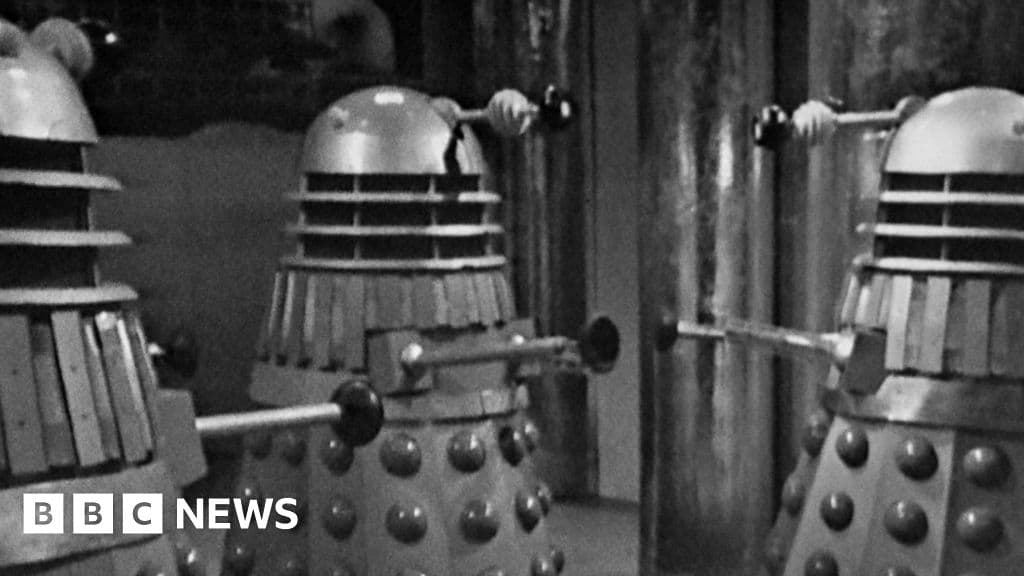
ShareSaveIsaac AsheandSimon Ward,East MidlandsShareSaveA cardboard box found in a collector's "ramshackle" collection of vintage films contained two episodes of Doctor Who that have not been viewed since airing in the 1960s.
The episodes feature the first incarnation of the Doctor, played by William Hartnell, tackling a Dalek plan to take over Earth, the solar system and the galaxy in a storyline only ever shown in the UK.
Peter Purves, who played the Doctor's assistant Steven Taylor, was invited to the Phoenix Cinema in Leicester on Wednesday under false pretences to view the two episodes, and he said: "My flabber has never been so gasted."
Restored versions of the episodes will be released on BBC iPlayer this Easter.
The first episode, titled The Nightmare Begins, was part of the third season of Doctor Who and was aired in November 1965.
The second recovered episode, Devil's Planet, was broadcast two weeks later.
The intervening episode, Day of Armageddon, was found in 2004 by a former BBC engineer, meaning fans now have the first three instalments of The Daleks' Master Plan arc.
Written by the creator of the Daleks, Terry Nation, and Dennis Spooner, the serial starred Hartnell and Purves alongside an early appearance by Nicholas Courtney as Bret Vyon, Adrienne Hill as Katarina, and Kevin Stoney as Mavic Chen.
Courtney would go on to play recurring character, The Brigadier.
But the "dark and gritty" 12-part storyline was ordered to be wiped, and more than half of it remains missing.
So how did they become the first lost Doctor Who episodes to be announced to the world since 2013?
The work of Leicester charitable trust Film is Fabulous! (FIF) is behind what had become the longest gap between lost episodes being uncovered coming to an end.
Many previous lost episodes had been found in archives of TV stations overseas, including the last episodes found, which had been recovered from a Nigerian TV station.
But with The Daleks' Master Plan, the story was not sold overseas.
Censors in Australia and New Zealand deemed it too violent, and without their buy-in, selling to other markets was not profitable.
Combined with the move towards colour, the black and white story was thought to have little future value and consigned to the bin.
But copies of some episodes were still made by technicians to check for problems which might need to be fixed ahead of pitching the episodes to other markets.
It was these versions that made their way to an amateur collection.
Professor of cinema and television history at Leicester's De Montfort University, Justin Smith - chair of trustees at FIF - said "a debt of gratitude" was owed to the anonymous late collector, whose films - largely focused on his love of trains and canals, including hundreds of home videos - were donated to FIF after he died.
He said: "We travel all over the country to recover film collections from private hands.
"A lot of the films had suffered water damage and the cans had corroded.